Procedural environmental law, also known as environmental democracy consists of three Pillars, which include the right of access to environmental information, the right of participate in environmental decision-making procedures and the right of access to justice. Environmental democracy is granted to citizens for their empowerment in order to protect their health against environmental damage and to ensure the environment. The aim of this study is to investigate the above rights in the international documents, jurisprudence and domestic legal systems of some leading states and then analysis the Iranian legal system with a descriptive-analytical method. We found that Iranian legal system still suffers from some gaps despite the positive efforts to achieve environmental democracy in recent years. The most important issues are the lack of specific rules on people’s access to environmental information, a favorable system for citizen participation in environmental decisions, and a dedicated environmental court.
Banisar, David, Freedom of Information and Access to Government Records around the World, Privacy International, 2002.
Berry, H., Koski, Laura Jessica, Verkuijl, Cleo, Strambo, Claudia, Piggot, Georgia, Making Space: How Public Participation Shapes Environmental Decision-Making, Stockholm Environment Institute, 2019.
Ebbesson, Jonas, Access to Justice in Environmental Matters in the EU, Kluwer, The Hague, 2002.
Khaleghi, Ali, Brief Commentaries on: Code of Criminal Procedure, The SD institute of Law, Research and Study, Publish 33, Tehran, 2019.
Kumar, Vikas, Malhotra, Geetika, Examining the Roles of IT and Social Media in Democratic Development and Social Change, Information Science Reference, 2020.
Pring, George, Pring,Catherine, United Nations Environment Program, Environmental Courts & Tribunals: A Guide for Policy Makers, Published by UN Environment, 2016.
Yanti Sulistiawati, Linda, Bouquelle, Farah J., et al., Environmental Courts and Tribunals; A Guide forPpolicy-Makers, UNEP, 2021.
- Articles
Bahreini, Hossein, Amini, Farhad, “The Role of Environmental Non-Governmental Organizations in Citizens Participation for Environmental Conservation in Iran”, Journal of Environmental Studies, vol. 26, Issue 26, 2000.
Birkinshaw, Patrick, “Freedom of Information and Openness: Fundamental Human Rights”, Administrative Law Review, vol. 58, No. 1, 2006.
Chakani, Mostafa, Hasani, Mohammad Hasan, “Strategies of NGO Participation in the Criminal Procedure (A Critical Review of Article (66) of the Iranian Criminal Procedure Code)”, Majilis & Rahbord, vol. 25, Issue. 94, 2018.
Gellers, Joshua, Jeffords, Chris, “Toward Environmental Democracy? Procedural Environmental Rights and Environmental Justice”, Global Environmental Politics, vol. 18, No. 1, 2018.
Ferrucci, Giada, "A Pioneering Platform: Strengthening Environmental Democracy and Justice in Latin America and the Caribbean", Journal of Management Policy and Practice, vol. 20, 2019.
Ghadir, Mohsen, “Right to Healthy Environment from the Perspective of International Human and Islamic Law”, Scientific Journal Management System, vol. 2, Issue 2, 2015.
Hemmati, Mojtaba, “The Role of the Judiciary in Preventing and Compensating for Environmental Damage in the Iranian Legal System”, Judicial Law Views Quarterly, vol. 23, Issue 81, 2018.
Madhuri, Parikh, “Public Participation in Environmental Decision Making in India: a Critique”, Journal of Humanities and Social Science, vol. 22, Issue 6, 2017.
Palmertz, Mark, “Regulating Environmental Law: A Review of the Aarhus Convention”, Translated in Persian by Ali Mashhadi, Davar Law Journal, Faculty of Law, Shahid Beheshti University, No. 2, 2009.
Pickering, Jonathan, Bäckstrand, Karin, Schlosberg, David, “Between Environmental and Ecological Democracy: Theory and Practice at the Democracy-Environment Nexus”, Journal of Environmental Policy & Planning, vol. 22, No. 1, 2020.
Ramezani Ghavam Abadi, Mohamad Hossein, Shamlu, Bagher, Sajjadi, Seyed Asghar, “A Comparative Study of the Concept of Access to Information in Arhuss Convention and the Law of Publication and Free Access to Information”, International Relations Research, vol. 6, Issue 21, 2016.
Ramezani Ghavam Abadi, Mohamad Hossein, “Examining the Content of the Principle of Participation in International Environmental Law”, Public Law, vol. 12, Issue 29, 2010.
Ramezani Ghavam Abadi, Mohamad Hossein, “The Preservation of the Environment in Iran's Constitution”, Judicial Law Views Quarterly, vol. 18, Issue 63, 2014.
Rengarajan, Sridhar, Palaniyappan, Dhivya, Ramachandran, Purvaja, Ramachandran, Ramesh, “National Green Tribunal of India: An Observation from Environmental Judgments”, Environmental Science and Pollution Research, vol. 25, 2018.
Rezaei Nandelli, Mahbobeh, “Executive Capacities of Iranian Public Law to Realize the Principle of Environmental Participation”, Environmental Science, vol. 11, No. 3, 2013.
Seifzadeh, Ali, “What I Ombudsman?”, Center for Administrative Health and Anti-Corruption Studies and Research, vol. 7, Issue 76, 2015.
Siekiera, Joanna, “Implementation of Legal Mechanisms of Environmental Protection by the South Pacific Regional Organizations”, Revista de Direito Internacional, Brasília, vol. 16, No. 2, 2019.
Shelton, Dinah, “Developing Substantive Environmental Rights”, Journal of Human Rights and the Environment, vol. 1, No. 1, 2010.
Smith, Don, “Environmental Courts and Tribunals: Changing Environmental and Natural Resources Law around the Globe”, Journal of Energy & Natural Resources Law, vol. 36, No. 2, 2018.
Vaca, Auz, Gabriel, Juan, “The Environmental Law Dimensions of an International Binding Treaty on Business and Human Rights”, Revista de Direito Internacional, Brasília, vol. 15, No. 2, 2018.
Varvaee, Akbar, Mohammadi, Hemmat, Norian, Ayub, “Participation of Non-Governmental Organizations in the Criminal Process”, Quarterly Journal of Private and Criminal Law Research, vol. 12, Issue 2, 2016.
Hjalmarsson, Karin. Access to Justice in Environmental Matters in the EU Member States, A Study of the Case Law from the European Court of Justice on Access to National Courts for Non-Governmental Organizations and the Costs of Environmental Proceedings, JURM02 Graduate Thesis, 2014, available at: <https://lup.lub.lu.se/studentpapers/ search/publication/4451220>, last seen 27 April 2023.
Njagi, Ngonge, David, Evaluation of Public Participation in Environmental Impact Assessment of the Southern Bypass Road in Nairobi, Kenya, A Thesis Submitted in Partial Fulfillment of the Requirements for the Degree of Master of Arts in Environmental Law of the University of Nairobi, 2015.
IACHR, Claude Reyes et al. v. Chile, Merits, Reparations and Costs, ser. C no. 151, 2006.
Ireland Court OF Appeal, Stephen Minch Commissioner of Environmental Information and Minister for Communications, Energy, and Natural Resources, No. 2016/255, 2016.
- Instruments
Access to Information on the Environment Regulations, 2007.
Code of Criminal Procedure, 2015.
A/CONF.216/16.
Covenant on Civil and Political Rights, 1966.
Convention on Access to Information, Public Participation in Decision-Making and Access to Justice in Environmental Matters, 1998.
Environmental Information Act, 2003.
Fourth Economic, Social and Cultural Development Plan of the Islamic Republic of Iran, 2013.
Iran Constitution, 1979.
Iranian Charter of Citizenship, 2017.
Law on Dissemination and Free Access to Information of Iran, 2009.
Moldovan Constitution, 1994.
Regional Agreement on Access to Information, Public Participation and Justice in Environmental Matters in Latin America and the Caribbean, 2018.
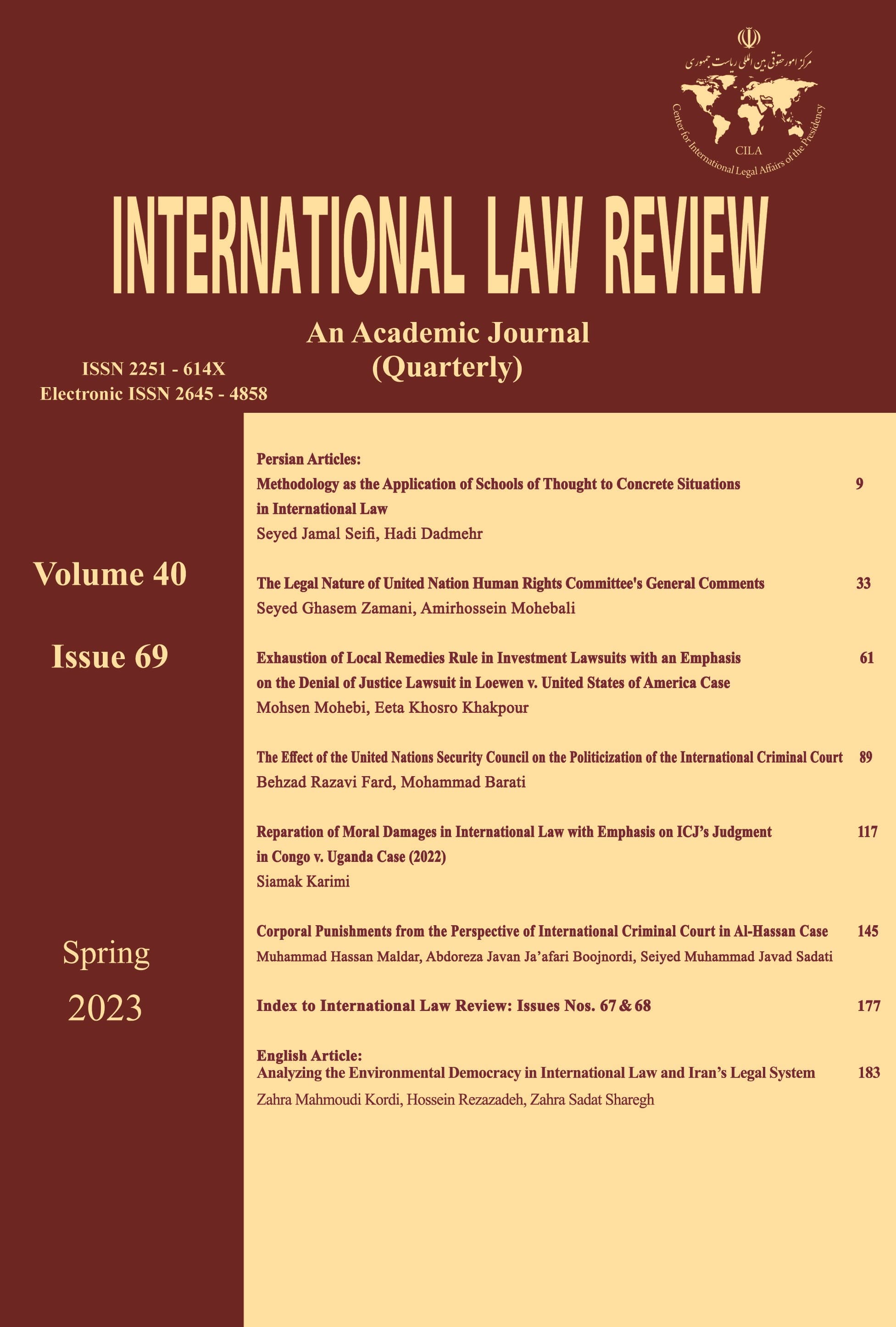
Mahmoodi,Z. , Rezazadeh,H. and Shareq,Z. S. (2023). Analyzing the Environmental Democracy in International Law and Iran’s Legal System. International Law Review, 40(69), 183-213. doi: 10.22066/cilamag.2023.704411
MLA
Mahmoodi,Z. , , Rezazadeh,H. , and Shareq,Z. S. . "Analyzing the Environmental Democracy in International Law and Iran’s Legal System", International Law Review, 40, 69, 2023, 183-213. doi: 10.22066/cilamag.2023.704411
HARVARD
Mahmoodi Z., Rezazadeh H., Shareq Z. S. (2023). 'Analyzing the Environmental Democracy in International Law and Iran’s Legal System', International Law Review, 40(69), pp. 183-213. doi: 10.22066/cilamag.2023.704411
CHICAGO
Z. Mahmoodi, H. Rezazadeh and Z. S. Shareq, "Analyzing the Environmental Democracy in International Law and Iran’s Legal System," International Law Review, 40 69 (2023): 183-213, doi: 10.22066/cilamag.2023.704411
VANCOUVER
Mahmoodi Z., Rezazadeh H., Shareq Z. S. Analyzing the Environmental Democracy in International Law and Iran’s Legal System. International Law Review, 2023; 40(69): 183-213. doi: 10.22066/cilamag.2023.704411